Why Listed Companies Must Elevate Sustainability Reporting
Why Listed Companies Must Elevate Sustainability Reporting

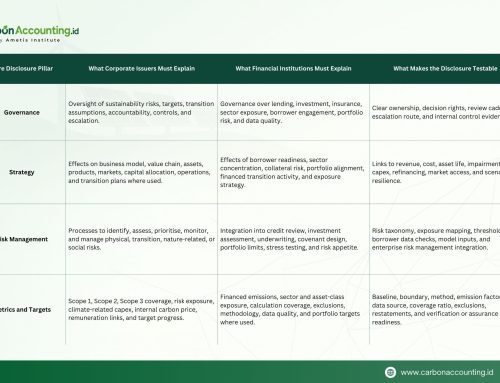
Comparison of sustainability reporting standards across the Indonesia (IDX), Singapore (SGX), Japan (JPX), and London (LSE) stock exchanges.
There’s no moment where sustainability is “finished”. The world changes, and the measurement rules move with it.
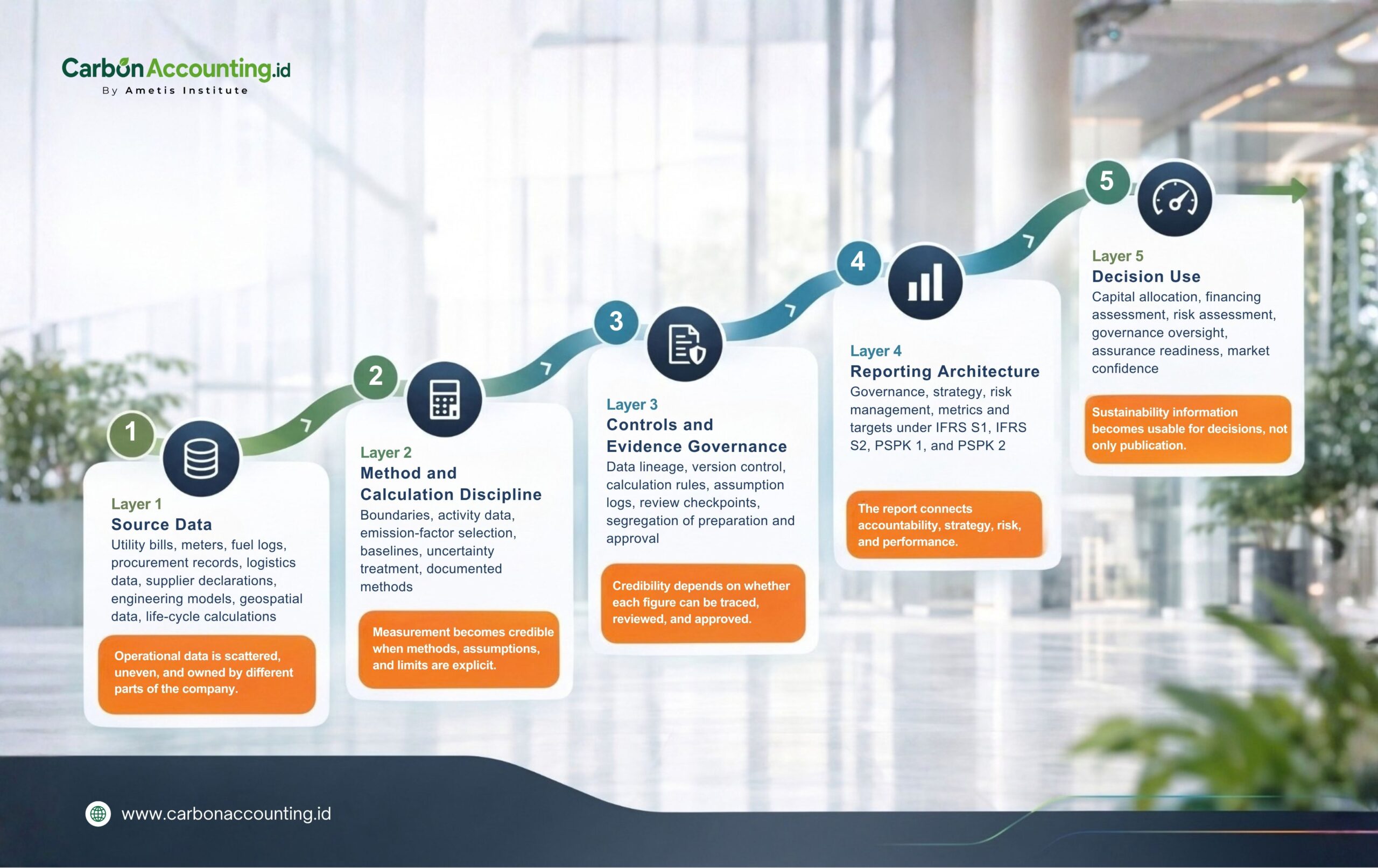
By mid-2025, Indonesia didn’t just “watch” the new disclosure era. We stepped into it. IAI brought IFRS S1 and S2 (ISSB) into our own framework as PSPK 1 and PSPK 2. And OJK has signalled a revision of POJK 51/2017, so what companies disclose here can stand on the same floor as the global baseline.
Why does that matter? We examine this issue in the context of the capital market. Because nowhere is “trust” tested more brutally than on the stock exchange, where disclosures translate into valuation, risk pricing, and access to capital.
Many listed companies in Indonesia already publish Sustainability Reports. But the format is still largely GRI-style: plenty of explanation, less clarity for decisions. Emissions numbers can feel like a summary of the past, not guidance for what leaders should do next: this quarter, this year, and over the next few years.
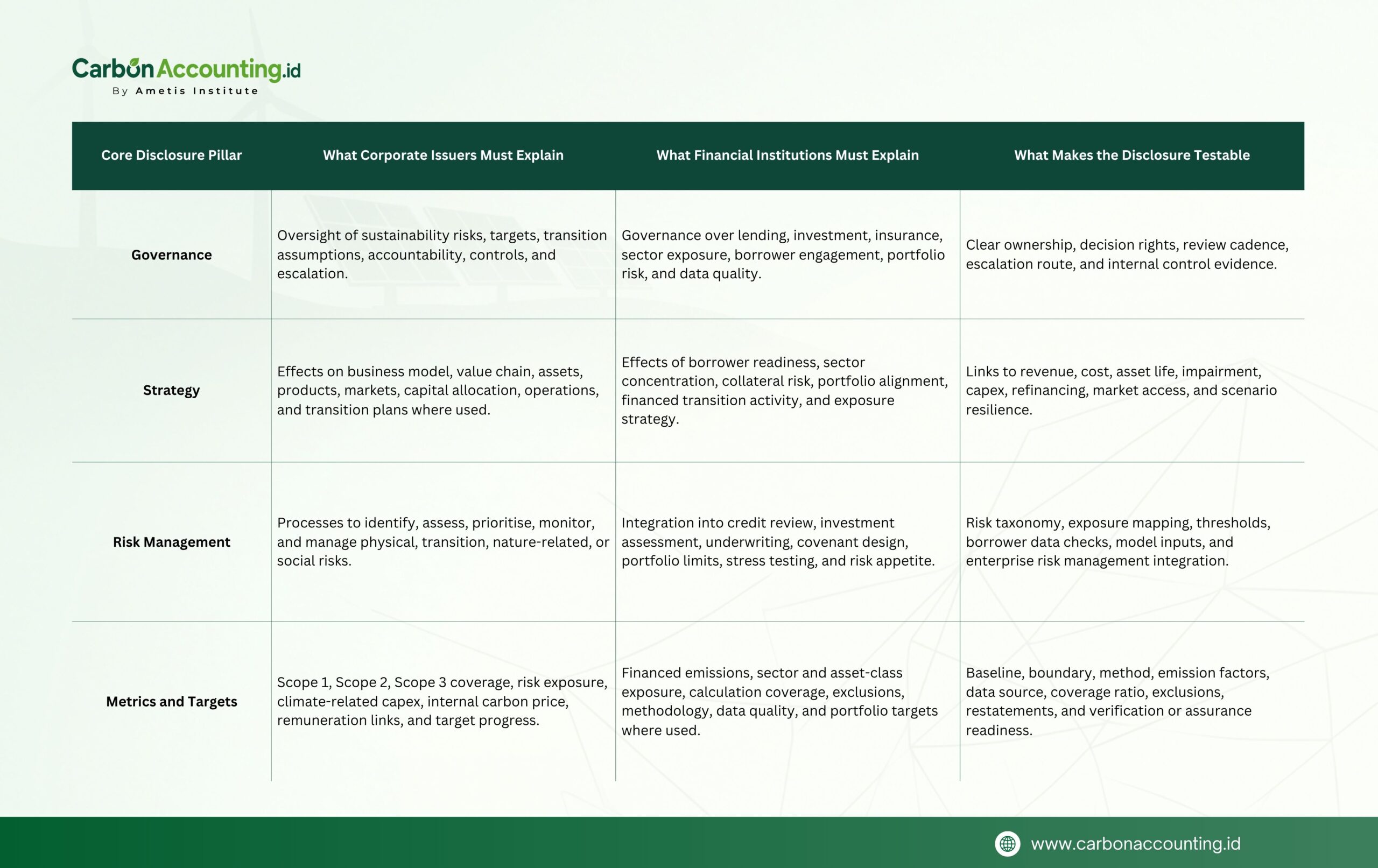
Global exchanges are moving toward a TCFD/ISSB style of disclosure: clear GHG inventories, physical and transition risk, and scenario analysis that shows how the business holds up under pressure. London still runs on TCFD, while preparing for the ISSB direction.
Singapore and Japan are going further: ISSB/IFRS-based climate disclosures are being phased in, and once in scope, the core elements become “must-disclose”. The message is simple: climate information should be testable, comparable, and ready for scrutiny, not just a good story.
That’s why updating POJK 51/2017 matters. If we want Indonesia’s disclosures to be taken seriously alongside other major exchanges, our rules need to move with the global baseline.
Global standards are the universal language of today’s growth. If Indonesian companies are to be heard globally, we must speak this shared language of sustainability.