Carbon Pricing Begins as a Signal
Carbon Pricing Begins as a Signal
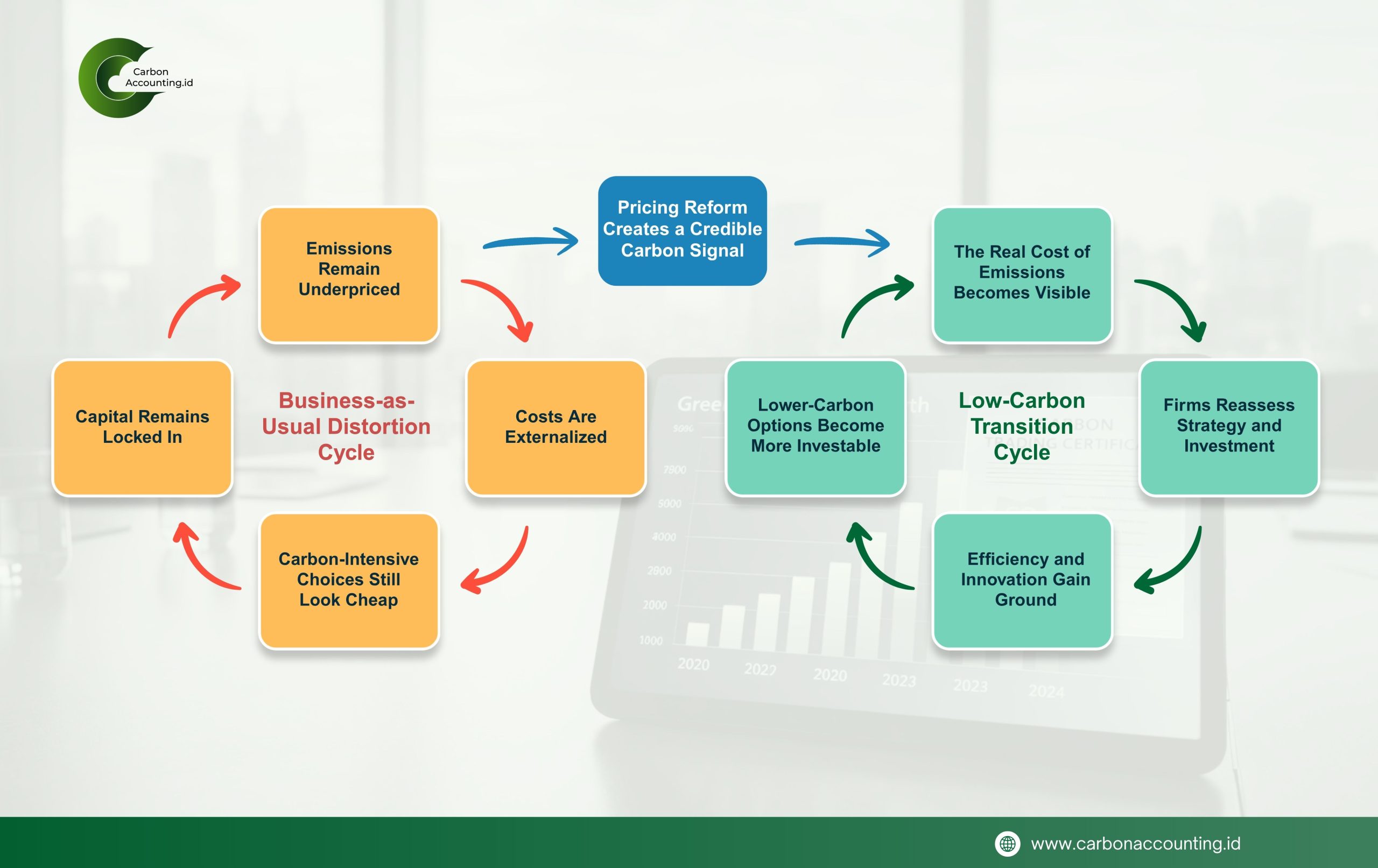
Carbon Pricing as a Signal: From Business-as-Usual Distortion to Low-Carbon Transition
A carbon price is never just a technical figure on paper. It is a quiet declaration of value, a way of telling the economy which choices can continue to look cheap and which ones must finally answer for their real cost.
That is why carbon pricing matters long before it functions as a tax instrument or a trading mechanism. Its first power lies in what it reveals. Once carbon is priced credibly, the market begins to see differently.
Without that signal, business calculations are easily distorted. Fossil intensive production, inefficient logistics, and delayed technology upgrades can still look efficient because part of their real cost is pushed outward to the public, to ecosystems, and to the future. The balance sheet looks cleaner than the economic reality.
A credible carbon price starts to correct that distortion. It tells management that emissions are no longer a side issue for sustainability teams alone. They become relevant to procurement, capital expenditure, fuel choice, plant design, product strategy, and long-term competitiveness.
This is why the strength of the signal matters as much as its existence. When the price is too low, too uncertain, or too easy to work around, most firms will not treat it as a serious signal. But once it becomes credible, it starts to enter real business judgment.
At that point, carbon pricing stops looking like a narrow environmental instrument. It starts to influence efficiency, innovation, risk review, and capital allocation. The issue is not only whether emissions are penalized, but whether expectations begin to shift.
That distinction matters for Indonesia. Before deciding whether Indonesia needs a tax, an emissions trading system, or some combination of the two, the more fundamental issue is simpler: will the signal be strong enough to change behaviour? A weak signal may satisfy policy symbolism while leaving investment behaviour largely unchanged.
This is also why carbon pricing should not be reduced to a debate about state revenue alone. Its deeper role is allocative. It helps steer capital away from activities that depend on unpriced damage and toward activities that fit a lower carbon economy more credibly.
In the end, carbon pricing is not powerful because it sounds modern. It is powerful only when it changes what firms do when they choose, build, buy, and invest. If the signal is faint, the economy keeps drifting. If the signal is credible, it begins to change course.