Indonesia’s Carbon Pricing Crossroads: Tax, Trading, or Hybrid?
Indonesia’s Carbon Pricing Crossroads: Tax, Trading, or Hybrid?
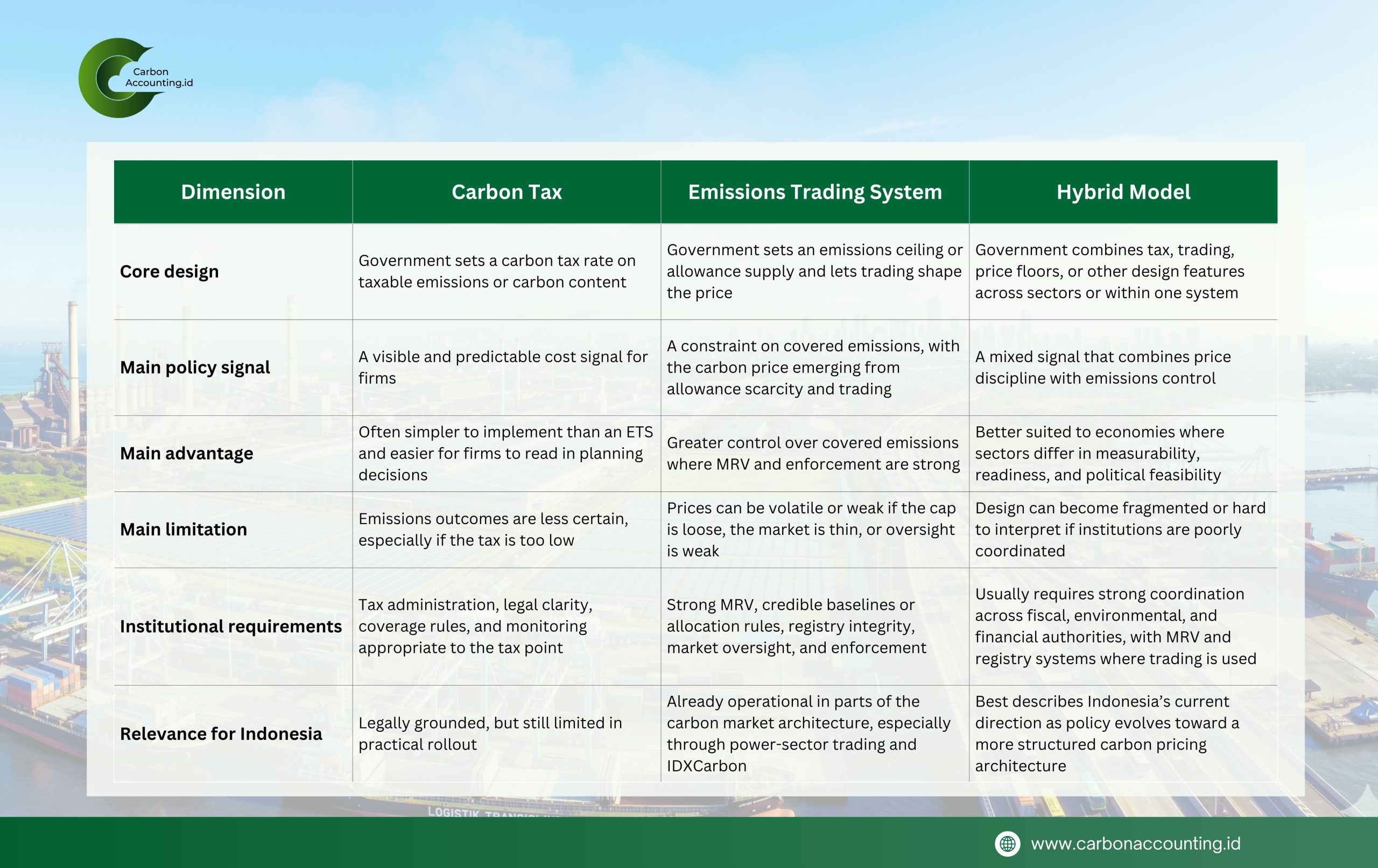
Comparing Carbon Tax, Emissions Trading System, and Hybrid Carbon Pricing
Carbon pricing matters because it tells the economy what kind of future is becoming expensive. But that message does not come in only one form. A tax speaks through a fixed charge. Trading speaks through scarcity and price formation in the market. A hybrid approach tries to combine control with flexibility. So, the question is not which instrument wins the argument. It is which design is strong enough to change business behaviour.
A carbon tax is often easier for business to read. The state sets the rate, firms can see the cost, and managers can start folding it into fuel decisions, procurement, and investment plans. Its advantage is clarity. Its weakness is that emissions outcomes depend on whether the price is high enough to change behaviour.
An emissions trading system works the other way around. The state fixes the emissions limit, then allows trading to shape the price. That can work well in sectors with large and measurable emissions. But it depends on credible baselines, strong monitoring, and enough market depth to keep the price meaningful.
That is why the real contest is rarely tax versus trading in the abstract. What matters is design. In practice, many jurisdictions mix instruments, add floors or other safeguards, and tighten the rules around credits and offsets when market integrity looks weak.
Indonesia now appears to be moving in that hybrid direction. The legal basis for a carbon tax already exists in Law No. 7 of 2021, with a floor of at least Rp30 per kilogram CO2e. At the same time, the state has put significant effort into building market architecture rather than relying on tax alone.
That shift became visible in February 2023, when carbon trading began in the power subsector. It became more visible again in September 2023, when IDXCarbon was officially launched under OJK supervision. Under OJK rules, the exchange can handle both PTBAE-PU and SPE-GRK, which means the system was built from the start to host more than one type of carbon unit.
The architecture widened further in January 2025, when Indonesia opened international carbon trading and stressed SRN integration, MRV, authorization, and corresponding adjustment. Later, Perpres 110/2025 replaced Perpres 98/2021, signalling a more structured institutional direction for carbon economic value instruments.
What is taking shape in Indonesia is not a pure tax system or a pure trading system, but a hybrid architecture still searching for strength. The framework is becoming more structured, yet structure alone does not guarantee influence. In climate policy, the real turning point comes when a price stops being a symbol and starts changing decisions.