When Carbon Pricing Meets Politics
When Carbon Pricing Meets Politics
When Carbon Pricing Meets Political Reality
Science may light the torch, but policy chooses the road. In the end, markets move less by discovery alone than by the price of risk and the will of the state.
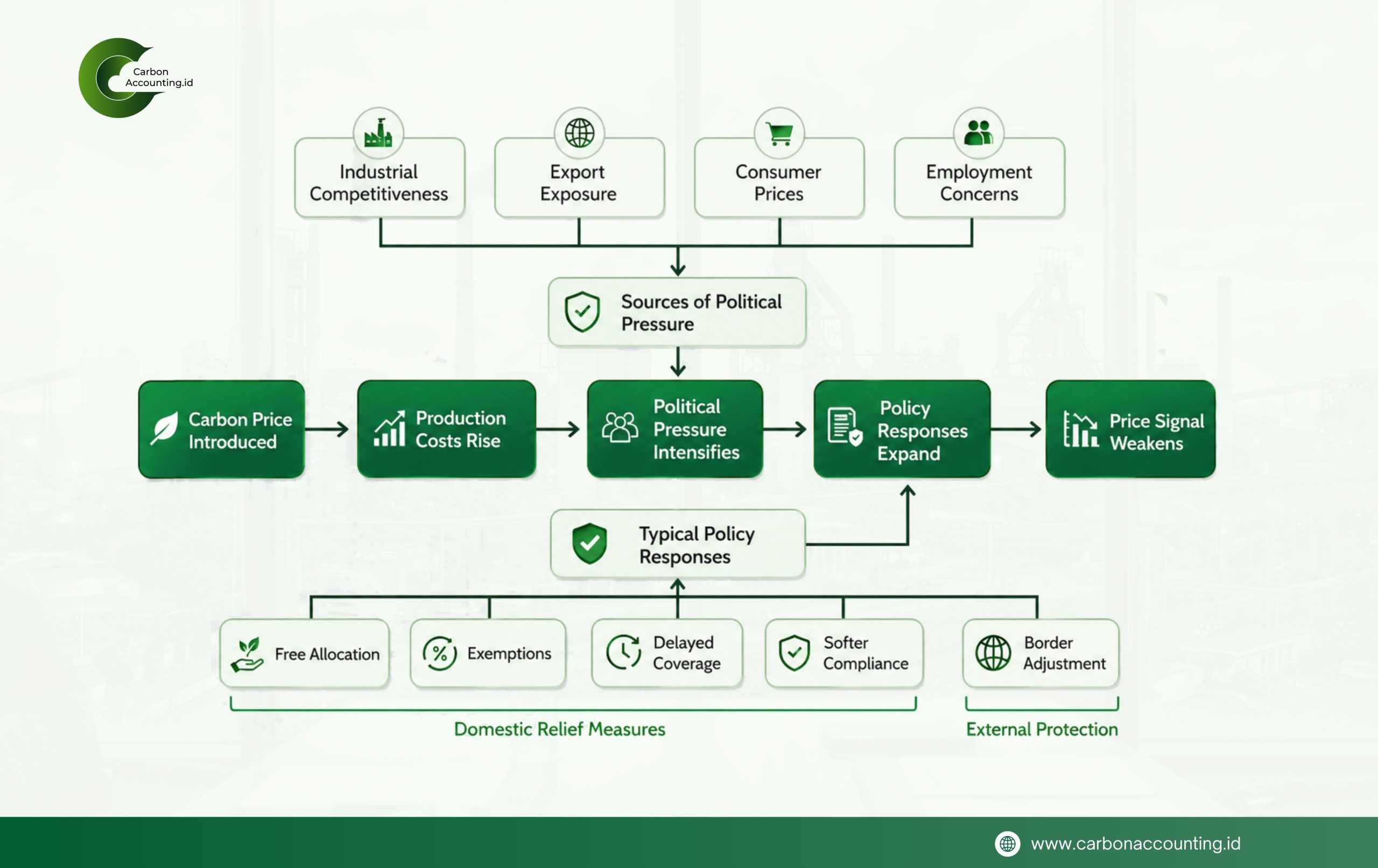
That is why carbon pricing becomes politically difficult the moment it leaves policy papers and enters production costs. What looks elegant in economics can feel disruptive in public life. Once costs rise, the pressure spreads quickly to factories, exports, prices, and jobs.
Carbon leakage has such power in this debate because it turns climate policy into a question of industrial survival. Once carbon costs begin to rise domestically, firms start comparing their position with competitors operating under looser rules. Some may choose relocation over reform. In that case, the economy bears the loss, while emissions are shifted rather than cut.
At that point, exemptions enter the conversation. Free allocation, delayed coverage, and softer obligations are often presented as practical safeguards. Sometimes they are. But when these protections multiply, the carbon price may remain visible on paper while losing much of its economic force.
At this stage, carbon is no longer the only issue at stake. The real question is how much disruption a government is willing to tolerate, and publicly defend, in the name of transition. Politicians may want to appear serious about climate action, but that resolve often weakens when inflation, industrial anxiety, and unwelcome headlines begin to gather.
In Indonesia, this tension is easy to see. Competitiveness, affordable energy, and employment are still politically sensitive concerns. Many companies are working in conditions where cleaner production is neither simple nor cheap. For export facing sectors, climate policy is no longer only a domestic issue. It is becoming part of trade exposure, buyer scrutiny, and market access.
That is why exemptions should be treated as temporary bridges, not as the foundation of policy. Relief may help manage adjustment where transition constraints are real. But relief without a clear time horizon can harden into hesitation. When that happens, carbon pricing stops guiding investment and starts acting more like a political symbol.
Border adjustments are often offered as a neat answer, but they solve less than they promise. They may reduce one competitiveness fear while creating new disputes over trade, compliance, and fairness.
The real danger is not compromise itself. The real danger is when compromise becomes the design, because a carbon price that cannot change behaviour is only a signal that has lost its voice.