The Taxonomy of MRV: From Climate Claims to Evidence
The Taxonomy of MRV: From Climate Claims to Evidence
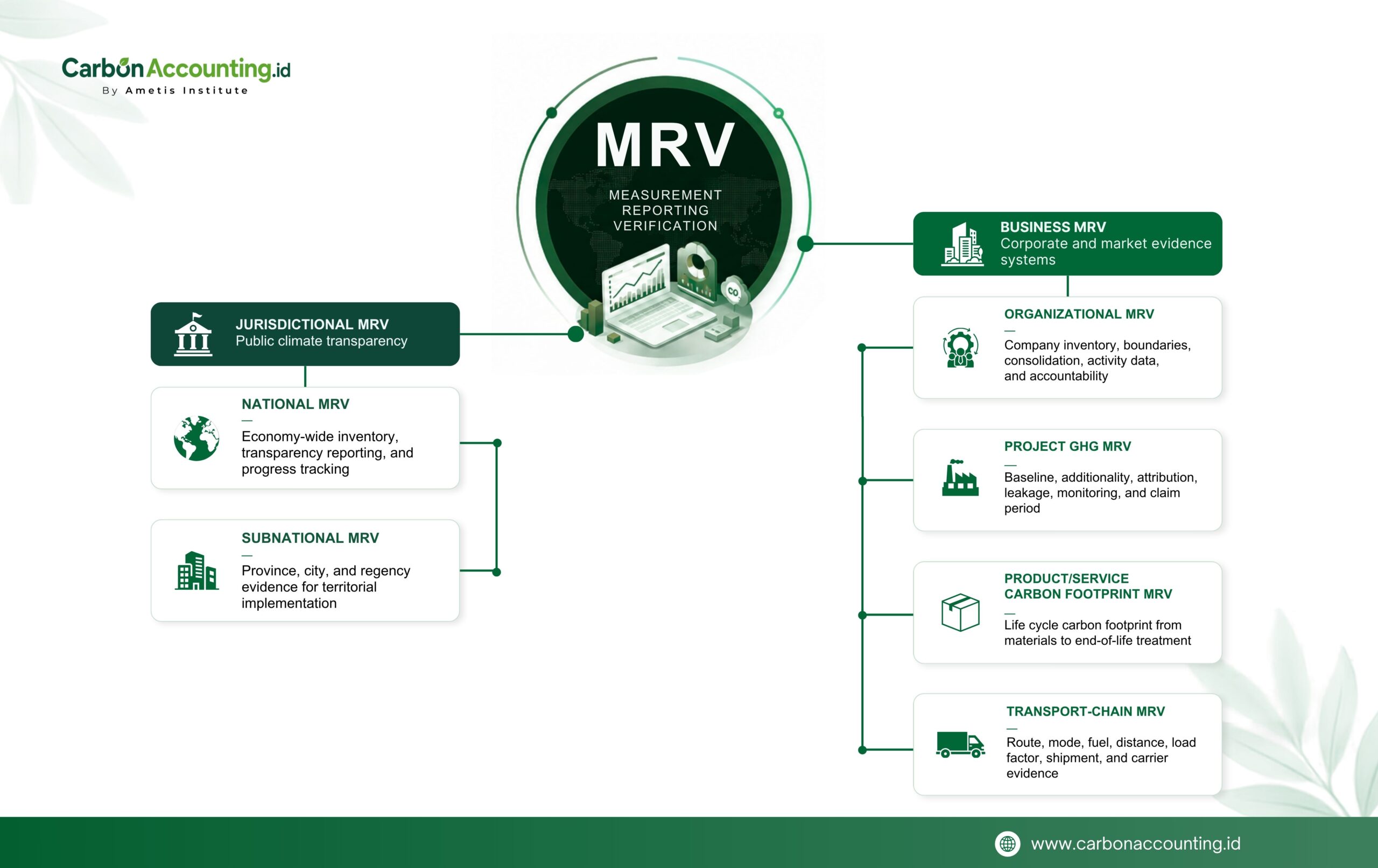
The Taxonomy of MRV
Climate ambition becomes serious only when it leaves an evidence trail. That is the role of MRV, or measurement, reporting, and verification. It turns promises into data, data into records, and records into claims that can be tested.
The problem is that MRV is often treated as one method. It is not. MRV is a family of systems, each shaped by its boundary, purpose, evidence, and claim. National MRV is not the same as corporate MRV. A project claim is not the same as a product footprint.
At the national level, MRV gives climate policy its evidence base. It brings together the practical data behind a country’s emissions profile, from fuel use and industrial output to agriculture, land management, waste treatment, and transport activity. Without this chain of evidence, national climate progress is difficult to explain and even harder to trust.
Subnational MRV works closer to the ground. Provinces, cities, and regencies need evidence that reflects their own territory and implementation choices. A city may focus on buildings, public transport, waste, and local energy use. A province may connect emissions with industry, peatland, forests, ports, or infrastructure.
For companies, MRV becomes more operational. Organizational MRV measures emissions and removals linked to company activities, using clear boundaries, activity data, emission factors, uncertainty treatment, documentation, and internal responsibility. This is the basis for disclosure, transition planning, and accountability.
Project GHG MRV asks a different question. It does not only measure change. It must show whether reductions or removals can be attributed to a defined intervention. That requires a credible baseline, additionality test, leakage review, monitoring method, data quality record, and claim period.
Product and transport MRV move the boundary again. Product foot printing follows carbon across the life of what a company sells, from materials to end-of-life. Transport-chain MRV looks at route, mode, fuel, distance, load factor, shipment, vehicle, and carrier performance.
This taxonomy matters because climate credibility begins with knowing which system is being used. National inventories, corporate inventories, project claims, product footprints, and logistics calculations are not interchangeable. When the taxonomy is confused, reporting may look precise while the evidence remains fragile.