The Real Climate Risk May Be Outside Your Fence Line
The Real Climate Risk May Be Outside Your Fence Line
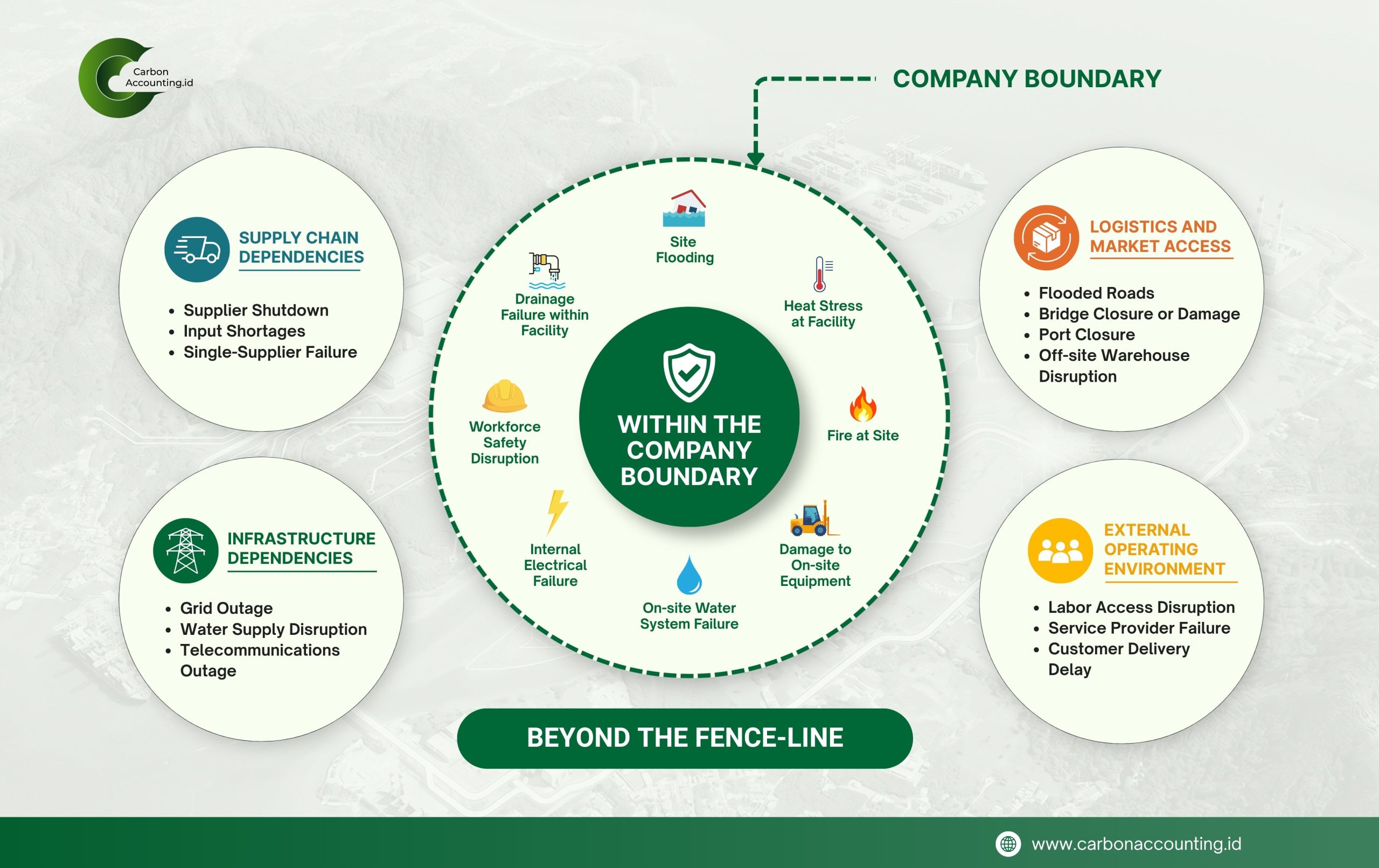
Climate Risk Within and Beyond the Company Boundary
Climate risk often reaches the business before it reaches the building. A factory may still be standing on dry ground while operations begin to slip because transport fails, power becomes unstable, or a critical supplier goes offline.
That is why climate analysis cannot stop at the site itself. It has to widen to the system that keeps the site alive. The real question is not only whether the asset can withstand a shock, but whether the wider network around it can still carry the business.
For many companies, the most material exposure sits in those outside links. Roads move workers and goods. Ports connect firms to markets. Power and water keep production running. Warehouses hold buffers. Suppliers provide inputs that may not be easy to replace. When these nodes fail, the company inherits the disruption whether it owns them or not.
This is where prioritization matters. Not every route, facility, or business relationship carries the same weight. Losing a secondary warehouse may be inconvenient. Losing the one bridge that handles most outbound shipments can be far more serious. A supplier with alternatives may be manageable. A single source supplier in a flood exposed area is not.
A useful starting point is to trace the chain from inputs to delivery and test each link. How central is it to operations. How exposed is it to heat, flood, fire, or surrounding infrastructure failure. If it goes down, how quickly can the business replace it, reroute around it, or restore it. The most important hotspots are usually the ones the company depends on most and can work around least.
Seen this way, climate risk is not just about weather. It is about whether the operating system still functions under stress. A factory can come through a storm with little physical damage and still miss its quarter because trucks cannot enter, containers cannot move, or electricity fails at the wrong moment.
That is why business continuity planning cannot stop at the property boundary. It has to reach into supplier strategy, route alternatives, backup utilities, inventory buffers, and the reliability of logistics and service partners. The companies that prepare well are often the ones that understand not only their assets, but also their dependencies.
Once that wider map becomes visible, another truth follows. Risk moves through relationships as much as through geography. The fence line is easy to draw. The real vulnerability often begins just outside it.