Monetary Valuation of Environmental Impacts
Monetary Valuation of Environmental Impacts
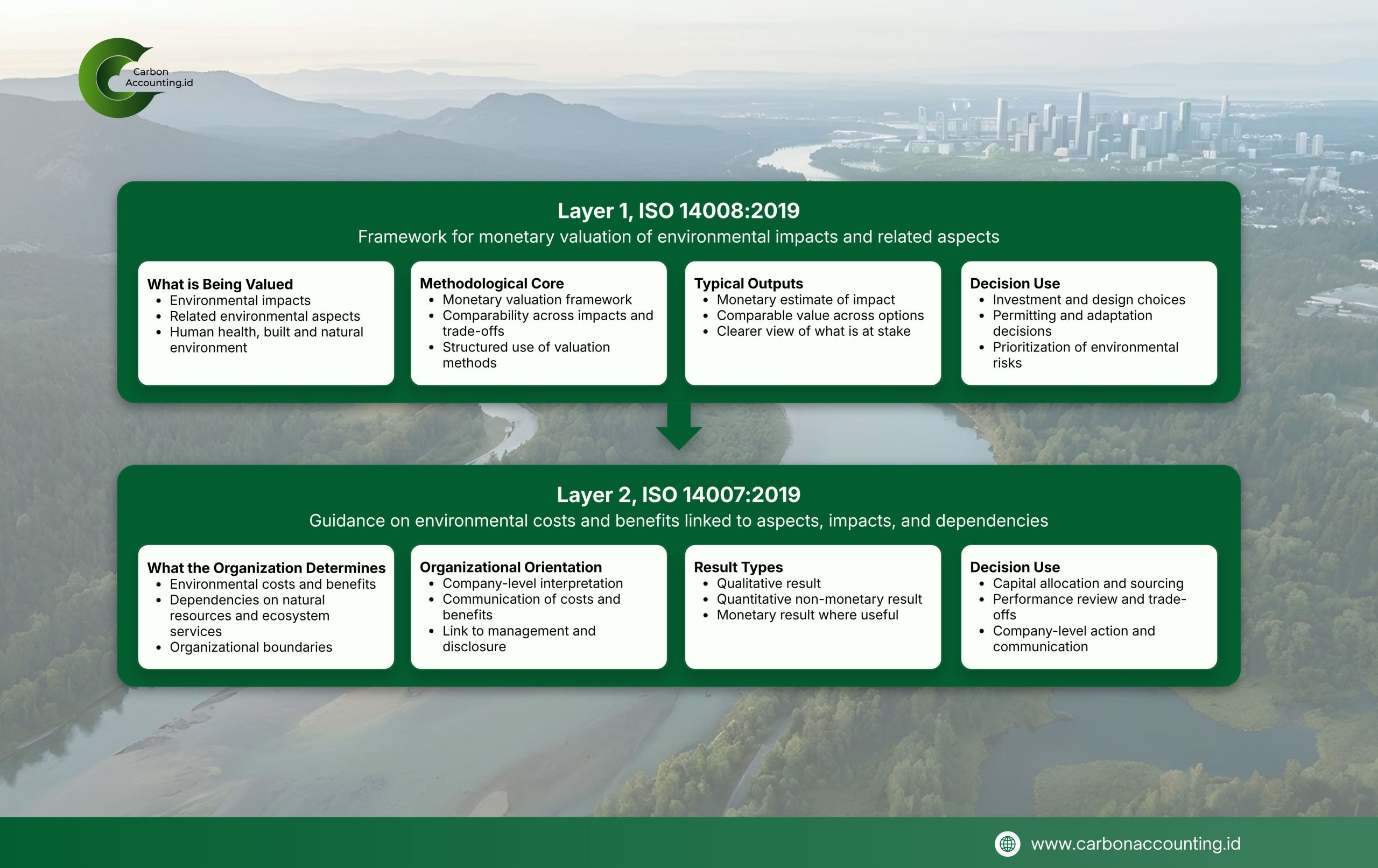
From Impact Valuation to Organizational Decision Use
Some environmental damage stays easy to dismiss until it enters the language of value. A river under stress, a watershed losing resilience, or a community living with poorer water quality may first look like problems outside the firm. The question changes when they begin to shape investment, permitting, sourcing, and risk tolerance.
At that point, the challenge is no longer only to measure impact. It is also to understand what is economically at stake. This is not about forcing nature into a crude price. It is about making environmental significance visible inside business judgment.
This is where valuation starts to matter. It gives firms a way to compare choices more carefully and to judge whether the cost of prevention may be lower than the cost of damage later. In that sense, the question is not only what has been affected, but what it may cost to wait.
ISO 14008 supports that step by providing a framework for the monetary valuation of environmental impacts and related aspects, including effects on human health and on the built and natural environment. Its value lies in giving decision-makers a more structured basis for judgment when environmental consequences need to be weighed alongside other business considerations.
ISO 14007 serves a different purpose. It helps organizations determine and communicate environmental costs and benefits linked to their aspects, impacts, and dependencies on natural resources and ecosystem services. Its results do not always have to be monetary. They may also be qualitative or quantitative, depending on what decision makers need.
That distinction matters. One standard sharpens the valuation logic. The other helps bring that logic into company decision use. Together, they help reveal why an option that looks cheaper today may carry larger environmental and economic costs tomorrow.
This becomes especially clear in water related decisions. A disruption may begin as an operational issue, but its wider significance may include treatment costs, project delay, ecosystem damage, community tension, or lost room for expansion. Valuation does not replace scientific assessment. It gives that assessment a language the boardroom cannot easily ignore.
This also fits naturally with TNFD. Once dependencies and impacts are identified, valuation can help organizations compare, prioritize, and prepare. But even that is not the final step, because value becomes most useful when it is tested against uncertainty.