Before It Reaches Finance, Nature Risk Begins on the Map
Before It Reaches Finance, Nature Risk Begins on the Map
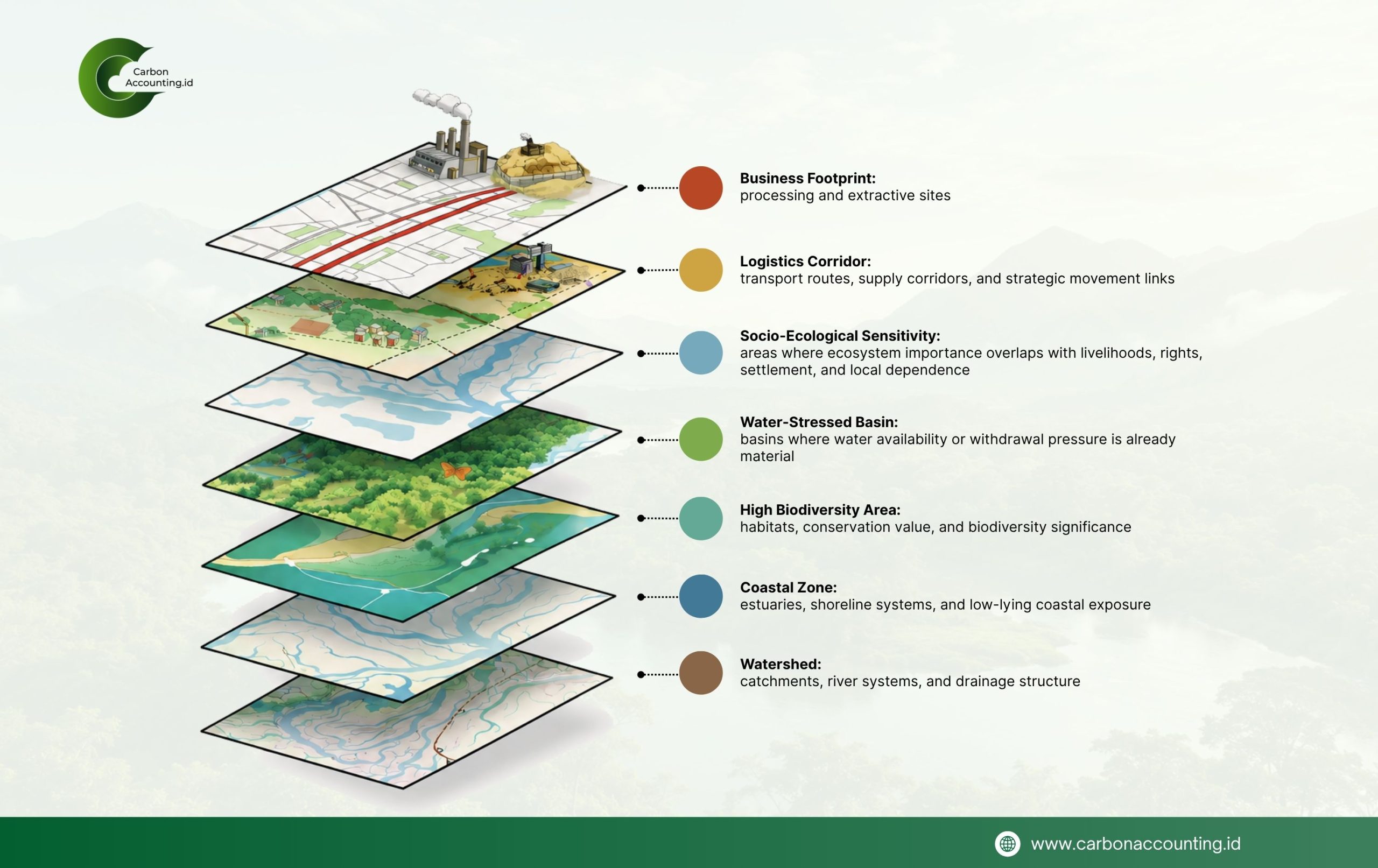
Layered Spatial Model of Nature-Related Business Criticality
Nature rarely arrives first as a line in a financial report. It arrives as a river that no longer gives with the same certainty, a landscape that loses its ability to absorb shock, or a supply route that crosses an ecology already under strain.
That is why nature risk must be read first as a matter of place. Before it affects valuation, cost, or continuity, it is already unfolding in specific watersheds, coastal zones, sourcing areas, and fragile landscapes with their own ecological limits.
This is where the discussion moves from awareness to method. TNFD’s LEAP approach helps firms locate and assess their interface with nature. The harder question comes next. Where does that interface become business critical. The answer is not found in a generic risk register, but in maps.
A company may look diversified on paper while remaining deeply exposed in one basin, one forest edge, or one agricultural supply area. Water availability differs by watershed. Habitat condition changes from one landscape to another. So do soil stability, pollination, flood buffering, and protection against erosion.
Once those ecological functions begin to weaken, the effects move quickly into operations. Production time can be lost when water becomes unreliable. Treatment costs can rise. Yields may fall on degraded land. Logistics can become more exposed to flood, sediment build up, fire, and heat.
The consequences do not stop at the site boundary. Sensitive locations often change the terms on which a project is judged. Permits may take longer. Lenders and public authorities may look harder. Buyers may ask for better proof of sourcing and traceability before they are willing to proceed.
The real threshold is crossed when dependence is concentrated in places that are hard to replace. A company may absorb stress in a secondary site, but not in the basin that supports its main production line or in the sourcing area that anchors critical inputs. That is why firms need layered spatial analysis, not just a list of environmental themes.
And nature materiality does not stay purely environmental for long. Sensitive landscapes are lived in, governed, and relied upon by others. Once business enters that setting, nature risk also becomes a question of rights, livelihoods, and legitimacy. In the end, nature becomes financially material when a place can no longer quietly carry the weight of the business built upon it.