Why Nature Risk Is Also a Social License Risk
Why Nature Risk Is Also a Social License Risk
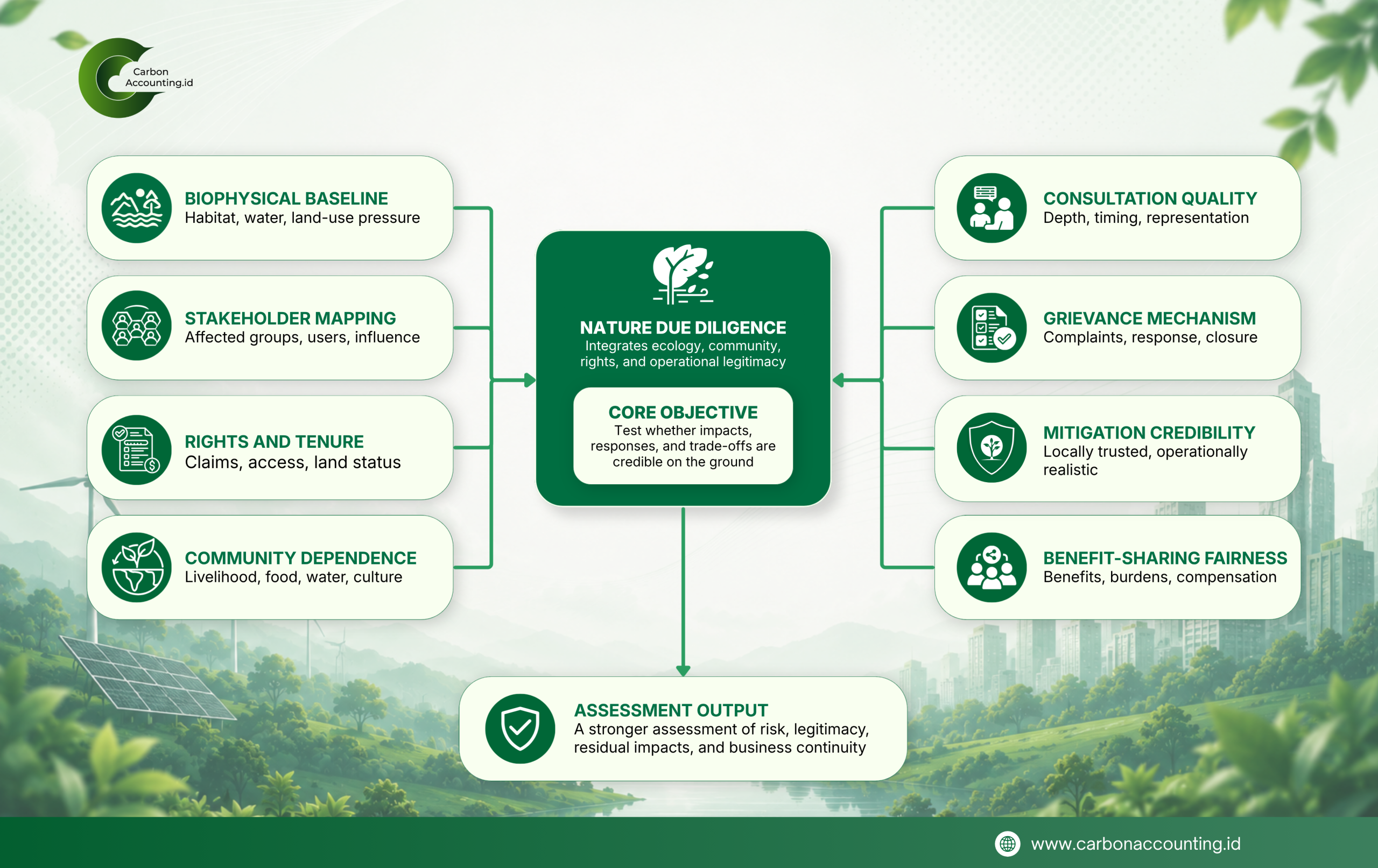
Nature Due Diligence Architecture: a technical assessment model linking ecological analysis, social legitimacy, and operating risk.
Nature becomes material twice. First when a river runs lower or a forest edge recedes. Then again when people begin to question whether a company still deserves to operate there.
That second moment matters because nature is never only physical terrain. A priority landscape is also a human landscape, held together by livelihoods, customary practices, water access, food systems, cultural meaning, and local knowledge built over time.
This is why TNFD does not treat communities as a side note to measurement. Its architecture places human rights, stakeholder engagement, and governance inside the process of identifying and assessing nature-related issues. In other words, the quality of the social relationship is part of the risk picture itself.
Taken seriously, this broadens the work of assessment. It is no longer enough to map habitat condition, land conversion, or pressure on water resources. A company also needs to know who uses the landscape, who depends on it, whose claims may be affected, and whose local knowledge helps explain how the place actually functions.
A riverbank, forest edge, or coastal zone may appear environmentally sensitive in a technical review. In reality, it may also support farming, fishing, seasonal movement, and places that carry cultural meaning. Once those dimensions are left out, the picture is already thinner than it should be.
That is often where the business implications begin to surface. Tensions over boundaries, access, water use, culturally important places, or benefit sharing can spread well beyond local unease. They can slow approvals, generate repeated grievances, draw legal scrutiny, unsettle investors, and interrupt operations.
The methodological lesson is clear. Good nature due diligence needs more than biophysical data. It needs social baselines, stakeholder mapping, records of consultation quality, and working channels for grievance and response. It also needs to test whether mitigation is trusted locally, whether benefit sharing is seen as fair, and whether residual impacts remain tolerable.
This is why social license should never be mistaken for public relations. It is the practical form of legitimacy where business, ecosystems, and communities meet. A company may still hold a permit, yet lose the trust that keeps operations stable.
Once biodiversity enters the same frame as water, rights, and community legitimacy, it ceases to be peripheral. It becomes a strategic matter of location, sourcing, and whether a company can remain not only present, but welcome.