Greener Care: How Patient-Level Carbon Footprints Can Transform Healthcare
Greener Care: How Patient-Level Carbon Footprints Can Transform Healthcare

CarbonAccounting.id develops an information system based on ISO 14067 and GHG Protocol to measure the carbon footprint of healthcare services.
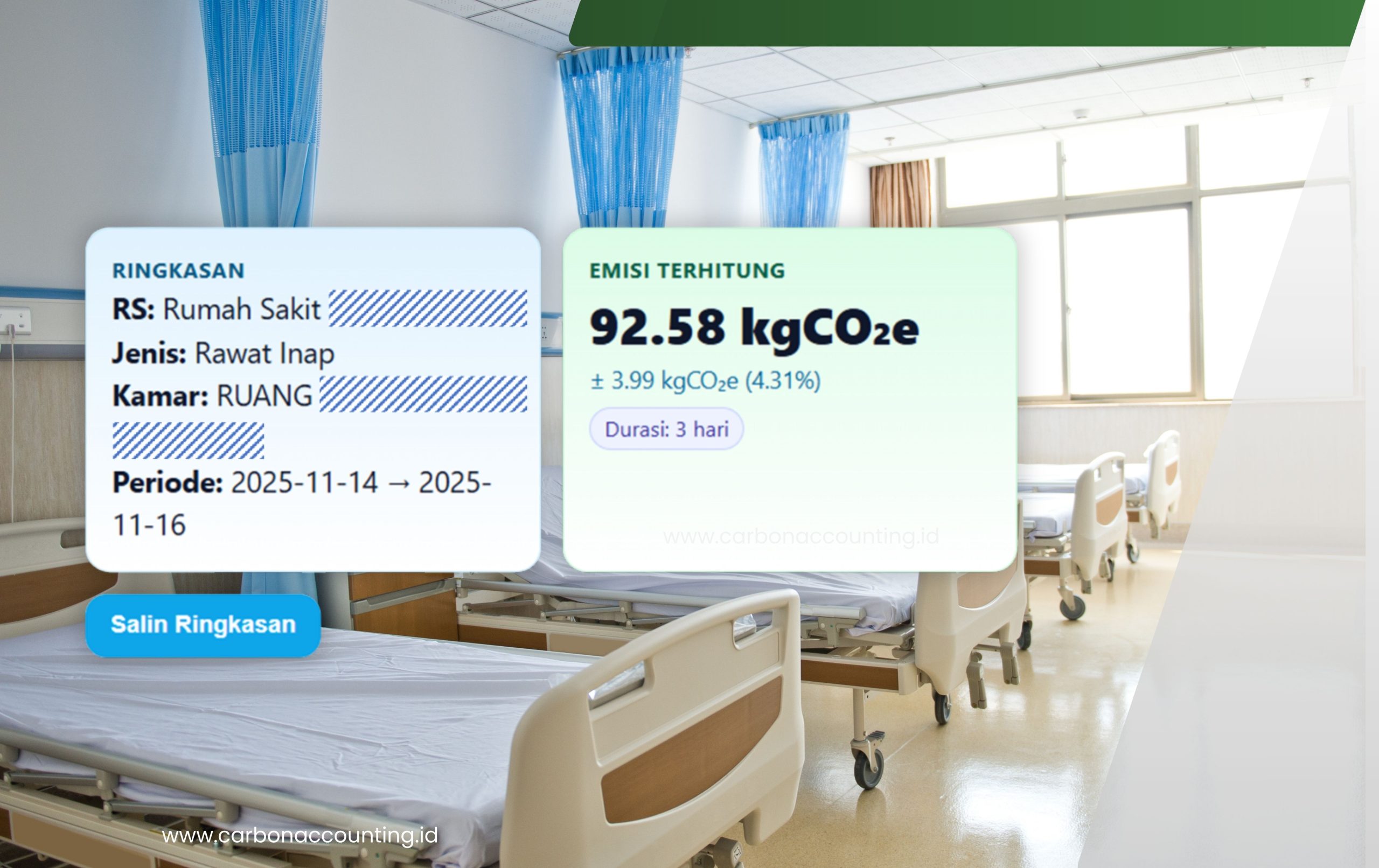
After selecting the type of treatment (inpatient/outpatient) and filling in the service details, the application will display the estimated GHG emissions from the healthcare services used.
The relationship between the health sector and climate change is not one-directional. It runs both ways. On the one hand, hospitals, clinics, and pharmaceutical supply chains are among the largest institutional contributors to greenhouse gas (GHG) emissions globally, through energy use, medical equipment, cold chains, waste management, and transport. On the other hand, climate change itself is driving a surge in demand for healthcare. More frequent heat waves, rising temperatures, extreme flooding, and shifting patterns of infectious and non-communicable diseases are all increasing the burden of illness and pressure on health systems.
In recent years, this dual crisis has increasingly come into focus on the global agenda. Discussions at the World Health Organization and the commitments voiced at COP26 have pushed governments and regulators to treat healthcare decarbonization as an urgent priority, not a side issue. These global commitments are now being translated into national regulations and ministerial decrees that require healthcare facilities to measure, report, and gradually reduce their GHG emissions. The question is no longer whether hospitals must manage their climate impact, but how they can do it in a way that is practical, credible, and aligned with international standards.
At CarbonAccounting.ID, we see research and technology as the critical bridge between ambitious commitments and day-to-day implementation. Measuring and mitigating emissions in hospitals cannot rely on rough estimates or generic emission factors alone. It requires robust methodologies and digital systems that can trace emissions down to actual services used by patients. In response to this need, we are developing an information system specifically designed to measure the carbon footprint of healthcare facilities. This system is built in accordance with ISO 14067:2018 and the GHG Protocol, ensuring that results are compatible with global best practice and can withstand scrutiny from regulators, auditors, and investors.
Our system works from the point of view that healthcare is ultimately experienced at the patient level. After choosing the type of care, such as inpatient or outpatient, patients or facility staff can input the admission and discharge dates, alongside the type of healthcare services used. Based on this information, the application estimates the associated GHG emissions for the healthcare facility and provides an indication of the uncertainty level. This makes emissions visible and understandable in a way that links abstract carbon figures to concrete episodes of care.
We believe this approach will deliver benefits far beyond regulatory compliance. By making emissions measurable and transparent, healthcare providers can identify operational inefficiencies, optimize resource use, and strengthen accountability to stakeholders. At the same time, giving patients insight into the climate impact of their healthcare can become a powerful educational tool, shaping expectations and creating demand for greener services. In the long term, we hope that solutions like this will help transform the health sector into a driver of climate action, protecting human health while actively contributing to the global effort to reduce GHG emissions.