The Cap Gap: What Holds Indonesia’s Carbon Market Back
The Cap Gap: What Holds Indonesia’s Carbon Market Back
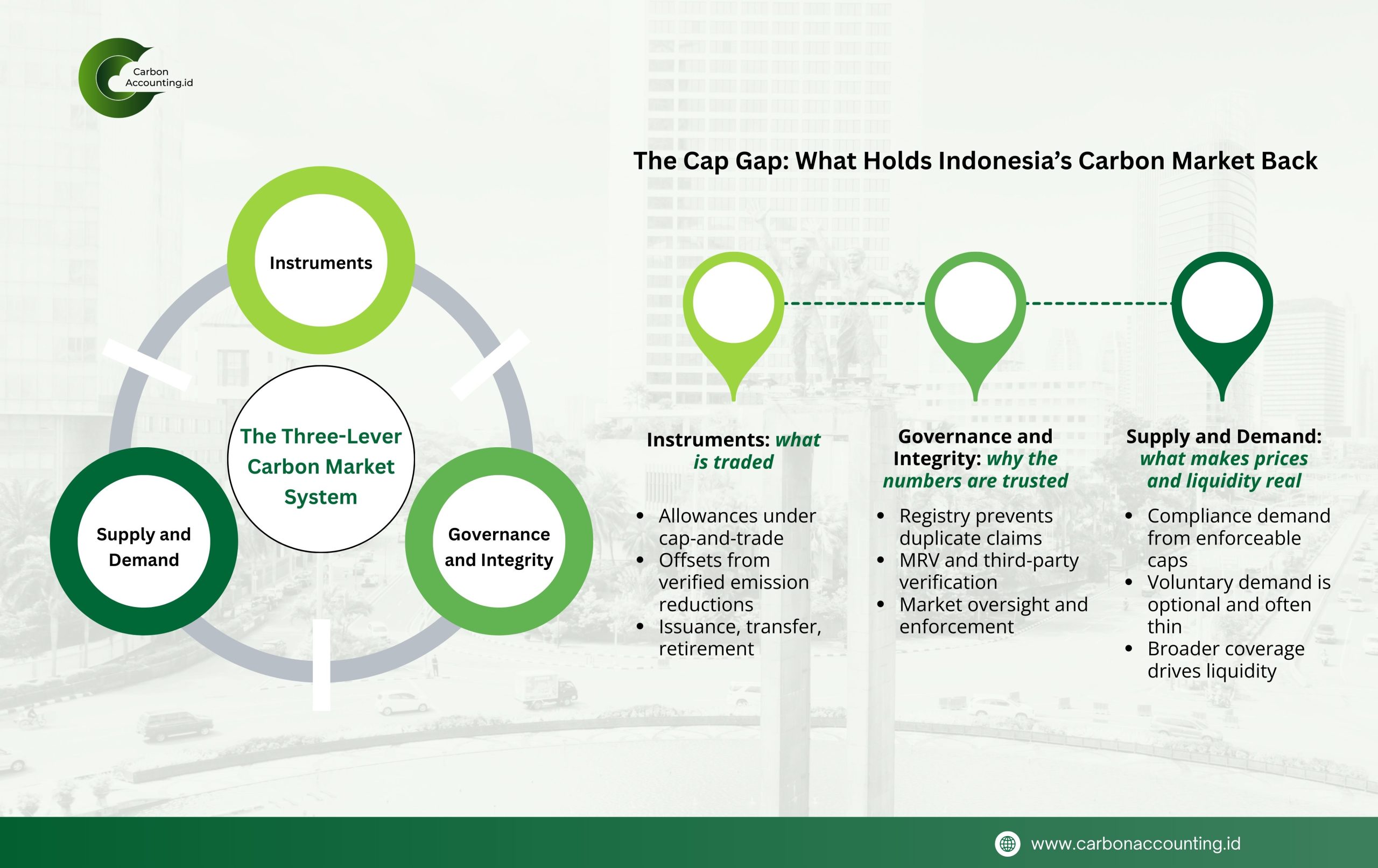
A carbon market scales when instruments, integrity, and supply and demand align as one system.
There is one law you cannot negotiate: energy is the product of power and time. To compress high output into a short window, the power must be immense.
In early February 2025, the government announced a target for the national carbon market to be fully operational by mid-2026, with large scale trading expected to begin in that period. The window of time is short. The power required to drive this change must be immense.
To hit that deadline, the work clusters into three levers: the instruments, the governance and integrity, and the real muscle of supply and demand.
On instruments, Indonesia is not starting from zero. Rules already recognize two main products: cap & trade allowances and offsets. Under a cap, firms that exceed their limit must buy units, while efficient players can sell their surplus. Offsets are units issued from verified emission reductions, supporting voluntary claims and, where regulation permits, limited compliance.
On governance and integrity, the scaffolding also exists. The national registry is designed to prevent duplicate claims, MRV is defined, and third-party verification is meant to separate real climate impact from marketing. Financial regulators have also outlined trading governance so the market does not become a credibility trap.
The missing piece is demand that is strong, predictable, and wide. Cap & trade are the engine that creates it, but today the emissions ceiling is still narrow. Technical caps for business actors have been set mainly in the electricity subsector, and even there they are focused on coal fired power plants. Other sectors and subsectors are still waiting for enforceable caps.
Can a market grow without caps? Yes, but it tends to become an offset only bazaar. Supply may appear, but demand stays optional, thin, and easy to postpone. Without firm ceilings, prices struggle to mean anything, and liquidity stays fragile.
Achieving large scale carbon trading by mid-2026 will require significant political power. This effort must be focused on one critical point: tightening emissions ceilings across key sectors.