Digital Product Passport Is Coming: No Data, No Market
Digital Product Passport Is Coming: No Data, No Market
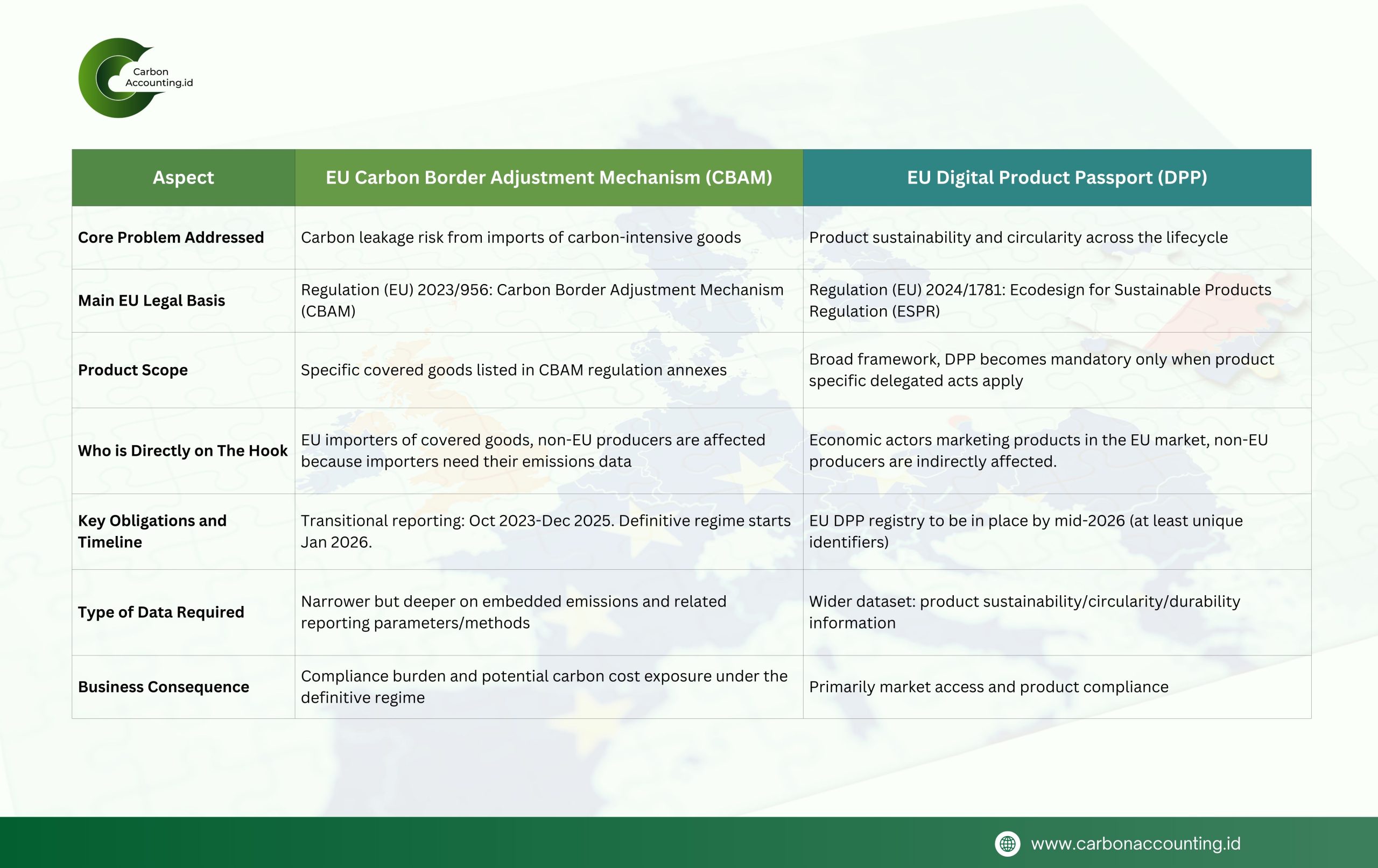
Comparison of EU CBAM and EU DPP as data-driven market access rules with different focuses.
Quality used to be enough. In the future market, transparency wins. Without a passport, your product loses relevance in the global supply chain. This is not about a human passport, but a digital identity for products.
The EU calls it a Digital Product Passport, or DPP, but the idea is simple. It is a digital record that follows a product. It lays out the product’s backstory and afterlife, what goes into it, where the important inputs come from, and how it is meant to be fixed or processed when it is no longer in use.
This is no longer a voluntary badge. The EU is building DPP into law through the Ecodesign for Sustainable Products Regulation, or ESPR. Product groups will be brought in gradually through sector specific rules, and the EU aims to have a DPP registry ready by mid-2026.
It also explains why DPP often gets mentioned in the same breath as Carbon Border Adjustment Mechanism (CBAM). Both policies turn market access into a question of traceable evidence. The difference is what they ask you to prove. CBAM is about embedded greenhouse gas emissions in imports. ESPR is about the wider circular economy picture and product sustainability across its lifecycle.
And the clock is already ticking. Under the EU Battery Regulation, a battery passport becomes mandatory from early 2027 for electric vehicle batteries, light means of transport batteries, and industrial batteries above 2 kWh. One deadline like that is enough to change how battery and critical mineral supply chains organise their information across the world.
After batteries, the next wave is highly relevant for Indonesia. The EU working plan highlights early priorities such as iron and steel, aluminium, textiles and apparel, furniture, tyres, and mattresses, with technical details set in delegated acts.
Outside Europe, most countries are still watching from the sidelines when it comes to formal DPP laws. But behind the scenes, the race is already on to set the standards. United Nations Economic Commission for Europe (UNECE) is pushing the UN Transparency Protocol, and different standards bodies are trying to make sure these passports can be understood across borders, not trapped in one region’s system. For companies, the smart move is not to obsess over the QR code. Start with the hard part: clean, consistent, auditable data from your own operations and your suppliers.
Forget the image of containers stopped by a physical barrier. The real barrier is increasingly a missing dataset. Transparency is now the entry ticket. No passport, no smooth access.