Why “Scope 4” Might Matter More Than Your Footprint
Why “Scope 4” Might Matter More Than Your Footprint
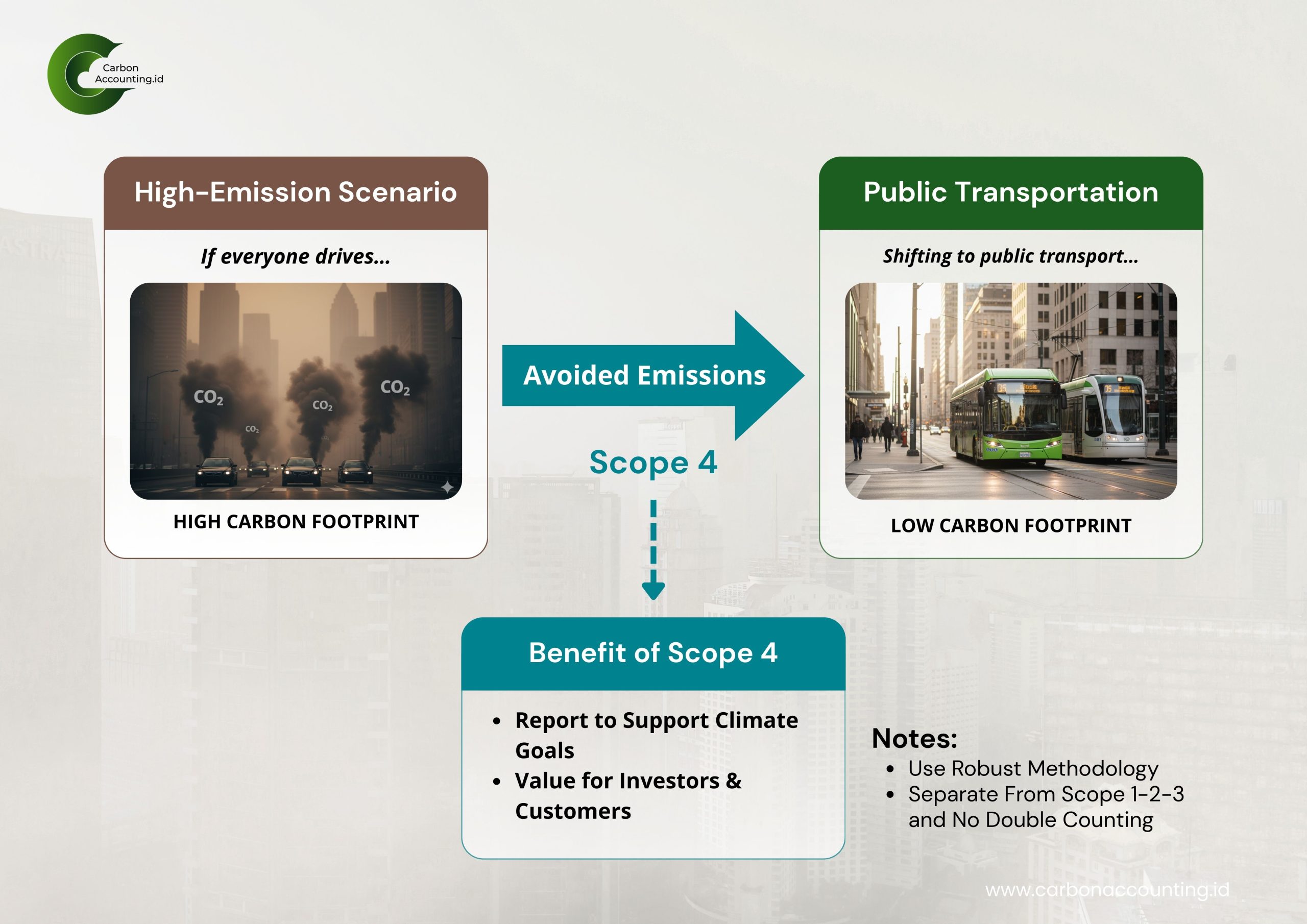
This schematic diagram shows how public transport creates avoided emissions (Scope 4).
The room wasn’t crowded, only 25 people. But every chair was taken by directors and senior executives of one of the country’s largest public transportation companies. We started with what we thought would be the “big” conversation: how a sustainability strategy can be designed to match a company’s vision, mission, and long-term plan. Something tailored, not copy-pasted.
Then we did a simple experiment. After the presentation, we sent an online questionnaire asking them to choose which sustainability direction felt most strategic for their business. The results landed like a plot twist. The top priority wasn’t energy efficiency, waste, or even “net zero” language. It was avoided emissions, what many people casually call Scope 4.
In plain terms, “Scope 4” usually refers to emissions that don’t happen because your product or service replaces a more carbon-intensive alternative. For a public transportation operator, the logic is immediate: every commuter who shifts from a private vehicle to a train or bus potentially reduces emissions. This is the kind of climate value that customers feel in daily life, but companies often struggle to quantify with confidence.
And there was a second reason it mattered so much to them: revenue. For many public transport operators, income isn’t only ticket sales. It also comes from Public Service Obligations (PSO), government support meant to keep essential services affordable and available. The executives were asking a practical question: if the PSO is also meant to support national climate targets, shouldn’t the “public benefit” include how much emissions were avoided through the service?
That’s where the conversation gets tricky and important. We explained that avoided emissions is not a replacement for the Scope 1-2-3 inventory. You can’t use it to “cancel out” your operational footprint. It is a separate claim, and it’s extremely sensitive to methodology: what baseline you compare against, which trips you assume would have happened, and how you prevent double counting with other actors. That’s why we advised them to use a widely recognized approach, such as baseline and monitoring methods that have a long history in carbon markets (for example, CDM-style methodologies).
That workshop left us with a quiet conclusion. Scope 4 may arrive sooner than many organizations expect, especially for businesses whose core model is already part of the transition. Done carefully, avoided-emissions accounting can become a powerful way to explain value to governments, customers, and investors, without sliding into greenwashing.
If you’re building a sustainable business model and want to explore what credible Scope 4 could look like for your sector, we’d be glad to talk.