Turning Forests from Source to Sink: Indonesia’s FOLU Pivot
Turning Forests from Source to Sink: Indonesia’s FOLU Pivot
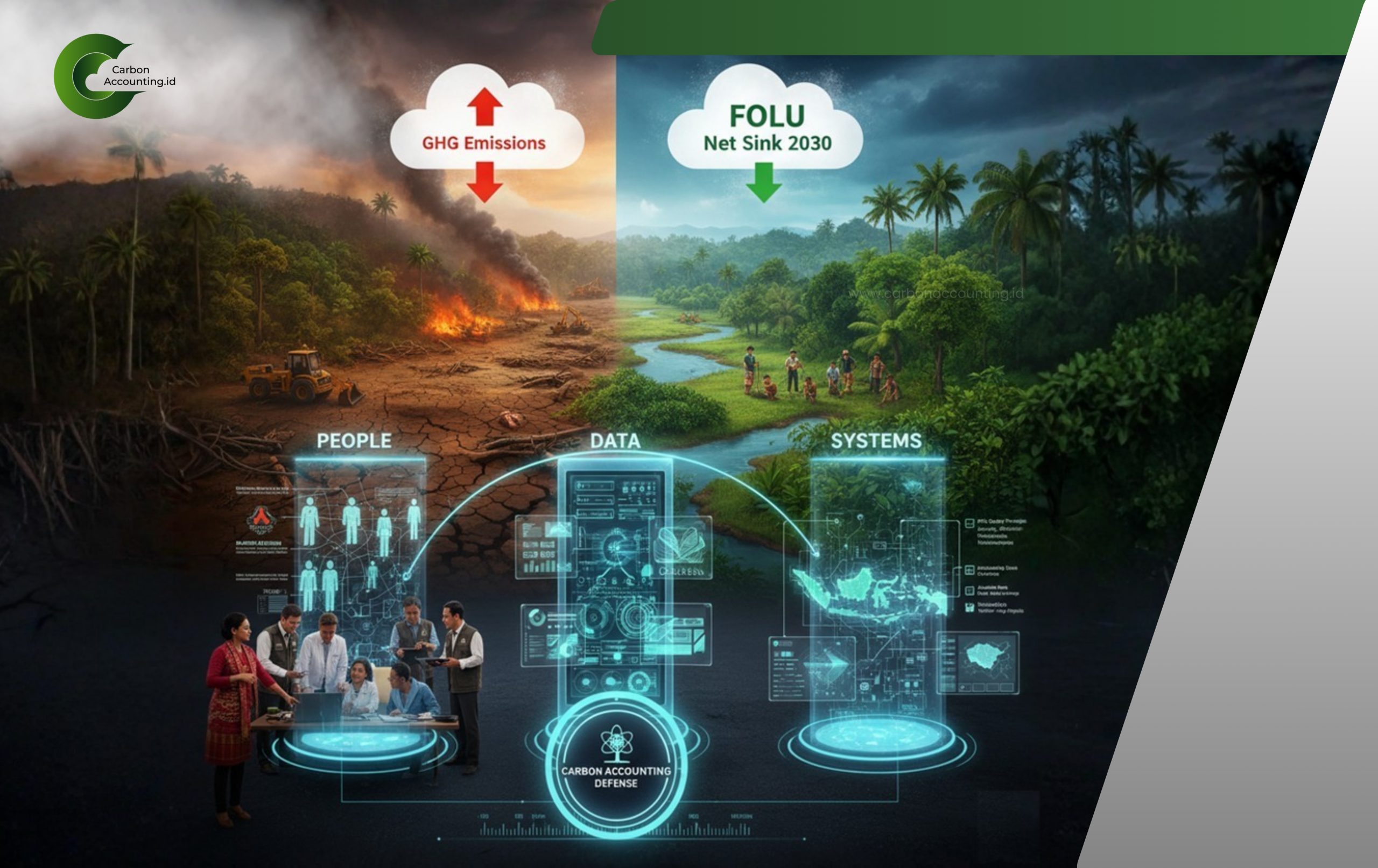
People, data, and systems are the three strategic pillars of credible, accountable carbon accounting to achieve Indonesia’s FOLU Net Sink 2030 target.
Indonesia’s land sector sits at the center of its climate story. Forestry and other land use, shorthand FOLU, accounts for a large share of national GHG emissions, driven by deforestation, forest degradation, recurrent fires, and the use and drainage of peatlands. These are not abstract trends. They are measurable sources that have shaped emissions trajectories for years. Yet the same landscapes that release carbon can, with different choices, store it, turning a liability into a long-term asset.
The government has put a date on that pivot. Under the FOLU Net Sink 2030 target, Indonesia aims for the sector to absorb more carbon than it emits by the end of the decade. The route to that milestone is clear in principle: slow and stop forest loss, restore damaged ecosystems, rehabilitate degraded areas, and manage forests for sustainability rather than extraction alone. The difficulty lies in implementation at scale and in the credibility of the accounting that will judge success or failure.
From CarbonAccounting.ID’s point of view, integrity begins with people. We have built a team trained to international standards, with our experts completing REDD+ Academy coursework and examinations supported by the UN-REDD Programme, UNEP, and UNITAR. REDD+ is more than a funding buzzword. It is a policy and methodological framework that codifies how to identify, measure, and reward reductions in emissions from deforestation and forest degradation, while embedding safeguards for communities and biodiversity.
Data is our second pillar. Indonesia’s forests are vast and varied, and so are the studies that describe them. We are assembling a structured, Indonesia-focused repository, encompassing peer-reviewed research, growth and yield information, and restoration evidence. The intention is straightforward: move beyond anecdote and toward reproducible estimates of removals, backed by documented sources and version control.
The third pillar is the information system that turns evidence into decisions. We are developing tools to calculate emissions and removals across forest and land-use activities in line with SNI 7725:2019 and IPCC principles: transparency, accuracy, completeness, consistency, and conservativeness (TACCC). In practice, that means clear boundaries, auditable data lineage, explicit treatment of uncertainty, and outputs designed for verification, so stakeholders can see how numbers were produced and on what assumptions they rest.
These three strands (people, data, systems) serve one purpose: to make land-sector accounting defensible in the public square. In a field where baselines are contested and interests collide; rigor is not an academic luxury. It is the shield against polemics and the precondition for trust. Companies, provincial authorities, and financiers all need to know that reported reductions and claimed sinks can withstand scrutiny. If Indonesia succeeds, the payoff will extend beyond a single target year. A FOLU sector that reliably functions as a carbon sink can push down national emissions at lower cost, safeguard peatlands and forests, stabilize rural livelihoods, and anchor a credible net-zero pathway. CarbonAccounting.ID’s commitment is to help make that outcome measurable and real, so that when the country counts its carbon in 2030 and beyond, it can do so with confidence.