Powered by ISO 14083, KAI Brings Transparent Rail Emissions to the Public
Powered by ISO 14083, KAI Brings Transparent Rail Emissions to the Public
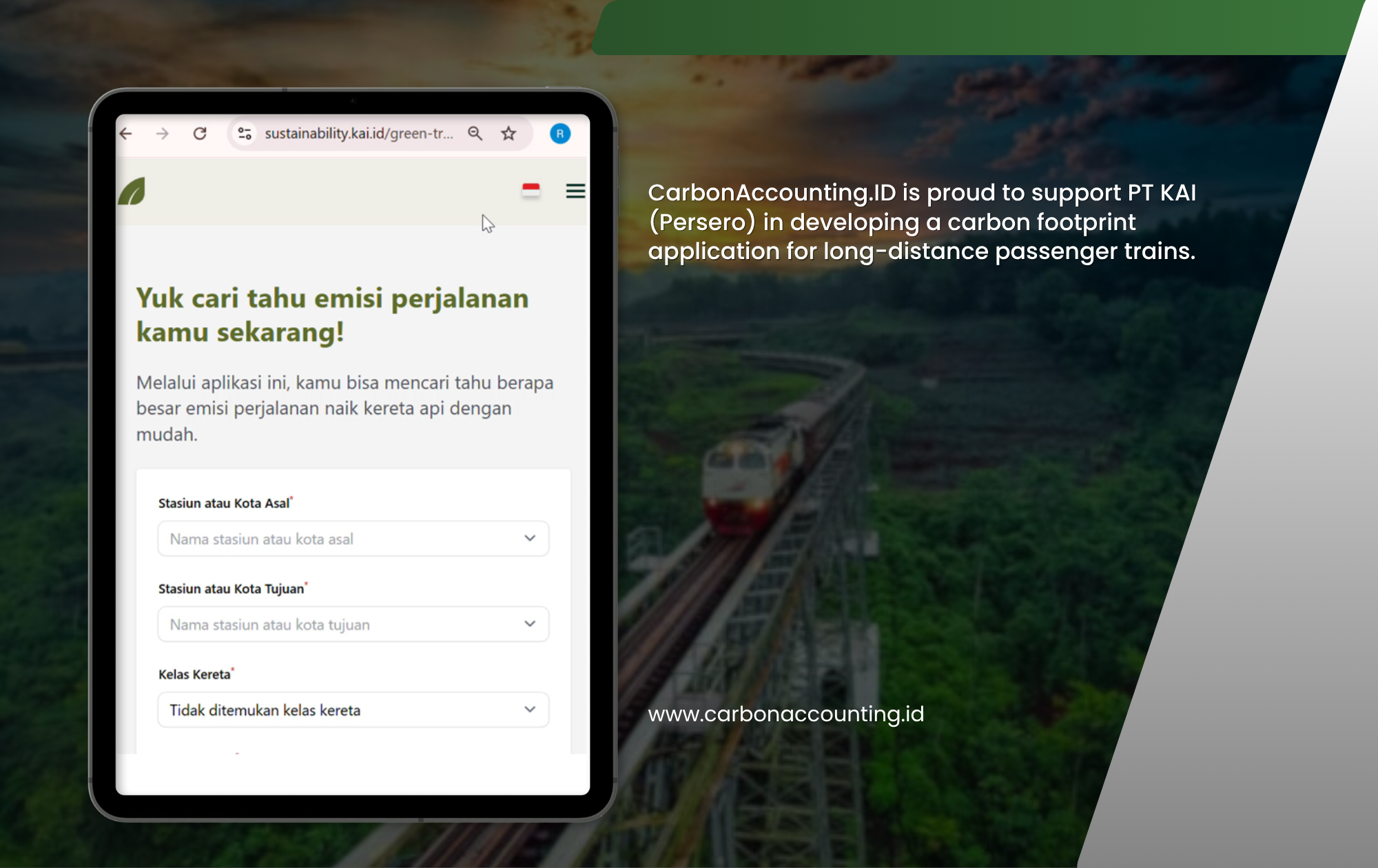
CarbonAccounting.ID is proud to support PT KAI (Persero) in developing a carbon footprint application for long-distance passenger trains.
PT Kereta Api Indonesia (Persero) marked a quiet but consequential shift in rail travel on September 29, 2025, with the launch of a public carbon footprint calculator for long-distance passenger services. For the first time, anyone can estimate a journey’s greenhouse gas emissions before committing to a ticket, turning an act that was once purely transactional into an informed choice. The calculator is available at https://sustainability.kai.id/green-transportation/carbon-calculator and is designed to be simple enough for first-time users yet rigorous enough for expert scrutiny.
From CarbonAccounting.ID’s perspective, the innovation is not the interface but the integrity behind it. The service is built on the ISO 14083:2023 standard, taking into account GHG emissions from facility (rolling stock) specific energy and refrigerants. Methodology is the backbone of credibility. The calculator applies a Tier-3 approach, the highest level recognized by the Intergovernmental Panel on Climate Change for emissions estimation, which relies on granular activity data and specific emission factors rather than broad averages. We paired this with a documented uncertainty analysis, so users and auditors can understand not only point estimates but also the confidence intervals around them. In climate reporting, transparency about uncertainty is as important as the numbers themselves.
The purpose is practical: to make lower-carbon choices easy and intuitive. By revealing emissions before purchase, the tool invites travellers to weigh route options, schedules, and service classes with environmental impact in mind, alongside price and convenience. In doing so, it reframes the ticketing moment as a climate decision point, where individual preferences and public goals can align without friction.
We are proud to have supported KAI in bringing this climate service to the public. A credible transition depends on sound methods, reliable data, and accessible design, and this project brings all three together. The result is a service that helps passengers act, helps KAI manage and reduce its footprint over time, and helps Indonesia move one step closer to a transport system that matches its climate ambition.