ISO 14083 for Indonesia’s Marine Cargo: IMO-Aligned and Indonesia-Specific Emissions
ISO 14083 for Indonesia’s Marine Cargo: IMO-Aligned and Indonesia-Specific Emissions
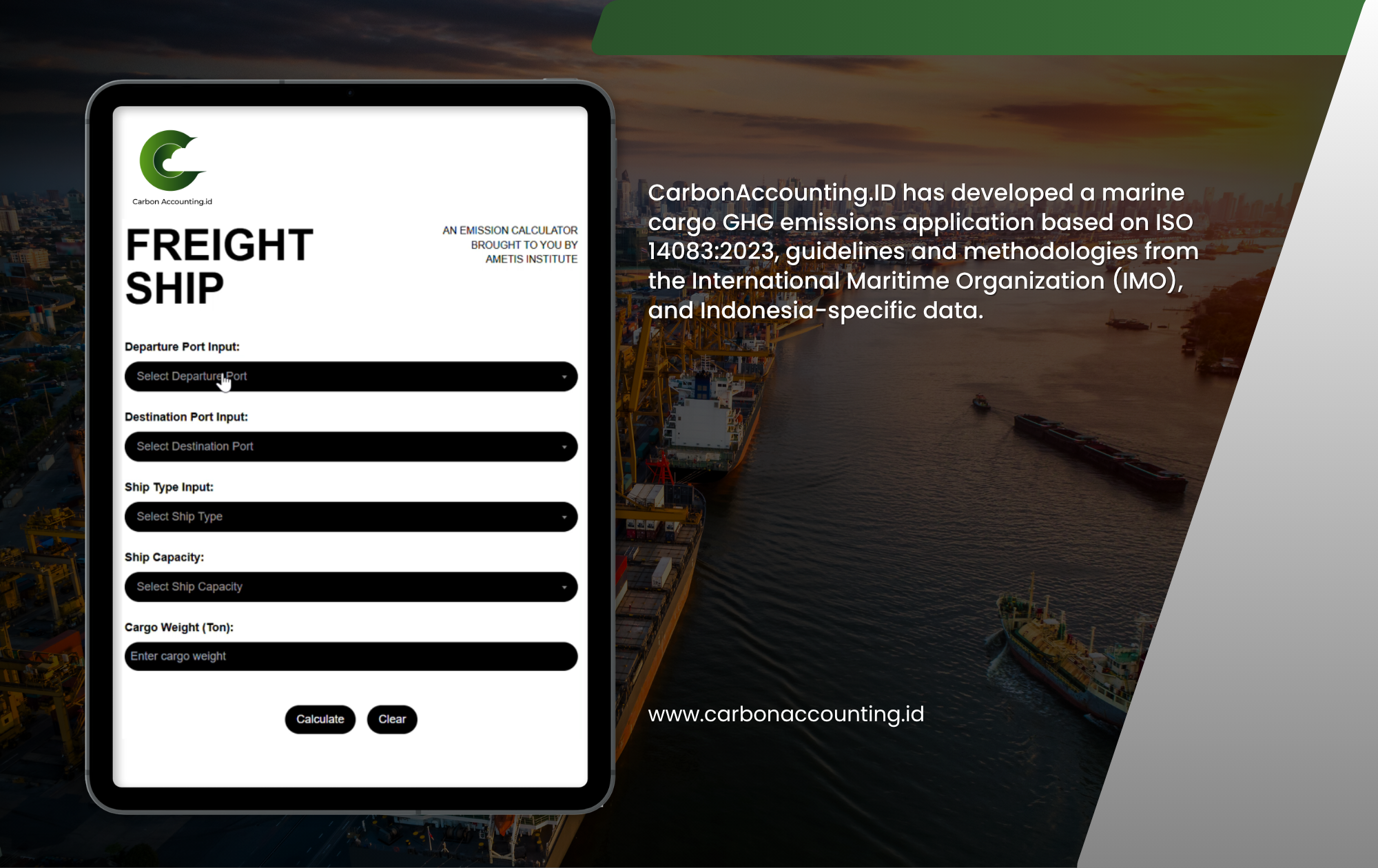
CarbonAccounting.ID has developed a marine cargo GHG emissions application based on ISO 14083:2023, guidelines and methodologies from the International Maritime Organization (IMO), and Indonesia-specific data.
Marine cargo is the quiet backbone of Indonesia’s economy, stitching together more than seventeen thousand islands with steady lines of supply. For businesses moving goods across this archipelago, sea freight isn’t optional, it’s the lifeline. When several of our strategic partners asked for a rigorous, locally attuned way to count the climate cost of these voyages, we listened. Their requests became the starting gun for a product that closes a crucial gap: a marine cargo greenhouse-gas (GHG) emission calculator built for Indonesia’s realities.
At CarbonAccounting.ID, we translated that demand into a working application designed for practitioners, auditors, and decision-makers who need numbers they can trust. The engine rests on ISO 14083:2023 for transport chain emissions accounting, enriched by technical guidance and methodologies from the International Maritime Organization (IMO). We pair those global guardrails with Indonesia-specific data, because a model that ignores local port conditions and sailing patterns is a model that misses the mark.
Functionally, users can map shipments to and from Indonesian ports along routes that reflect actual domestic shipping lanes, not generic straight-line estimates. The application accommodates a wide spectrum of vessel classes and sizes, from coastal feeders to larger bulk and container ships, so emissions factors and operational parameters better match reality. By grounding each estimate in route geometry, vessel characteristics, and operating profiles, the platform lifts results out of the realm of approximation.
Crucially, the system doesn’t stop at a single number. Every calculation is paired with uncertainty analysis to surface data confidence and model variance. That transparency supports legal and compliance needs while giving sustainability leads, lenders, and regulators a clear window into assumptions and ranges. In practice, it means procurement teams can compare routing options with eyes open, and logistics managers can defend decisions with auditable, standards-aligned evidence.
This product reflects our broader thesis: credible climate transition is impossible without rigorous methods and usable tools. We built the marine cargo module to embody the TACCC (transparency, accuracy, consistency, comparability, and completeness) principles so that companies can measure what matters and act with confidence. For an archipelagic nation whose growth rides the waves, turning marine cargo emissions from guesswork into governance isn’t just good accounting, it’s good strategy